
Teachings from a Diné youth: Representing Hózhó through story
Tifiny Mills, Christina Morgan, Eileen Quintana, Breanne K. Litts, Dallas Haws, Analysa Allison, Natalie Billie

Native After School Program
Title IV funded
They work to create safe, healthy, and supportive learning environments for indigenous youth and their families, bringing indigenous ways of knowing, being, and doing into an urban environment.
University Research Team
Utah State University
National Science Foundation Grant
Community Driven & Value Centered Design
Partnership & Collaboration
Coming Together
Hózhó
A way of Living in Balance, Beauty & Harmony
Six Attribute of Hózhó
Kahn-John Diné M, Koithan M. Living in health, harmony, and beauty: the diné (navajo) hózhó wellness philosophy. Glob Adv Health Med. 2015 May;4(3):24-30. doi: 10.7453/gahmj.2015.044. PMID: 25984415; PMCID: PMC4424938.
Respect
“...the act of maintaining loyal reverence by offering respect to self, others, nature, spirit, animals, the Creator, and the environment.”
Spirituality
“...expectation to respect and honor spirit through prayer, paying homage to spirit, ritual ceremony, and spiritual/religious practice.”
Reciprocity
“...the constant, graceful and respectful exchange and receipt of support, acts of kindness, helpfulness, and tokens of appreciation or honor- nothing is ever received without giving...”
Relationships- K’é
“(Ké—the Diné connectedness to family, clan, tribe, community) is a central theme, requiring a constant awareness of the relationships and interconnectedness between one and the environment (others, family, community, tribe, spirits, people of the world, all living creatures, nature, and the universe).”
Discipline
“...the commitment to achieving life goals through sustaining disciplined productive daily activity in the form of study, self-care, physical activity, and helpfulness to others.”
Thinking
“... the cognitive functioning required to maintain consistent positive thought while planning and organizing the present and future.”
Raya’s Digital Art Works
Research Question
How do Native youth enact Hózhó through their digital storytelling process?
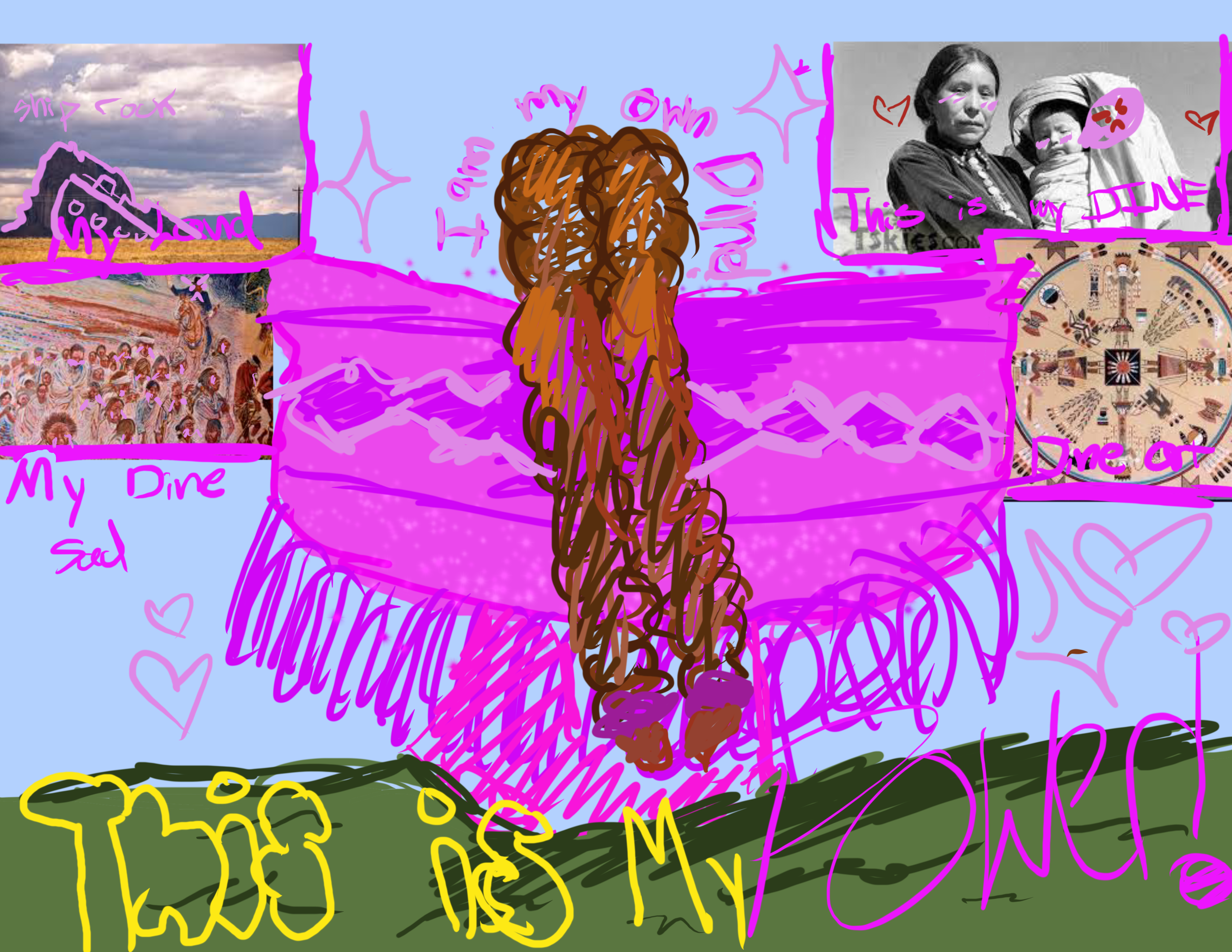
"...The title of my video is 'The Power of my hair. I created this video because I cut my hair a long time ago and I really wanted to show Native Americans, that it is possible to do anything with your hair and keep it long, and every Native American Tribe you keep your hair long. In Navajo, you always keep it. I wanted to share this video with you because a long time Native Americans and any tribe were not allowed to keep their hair long. And I wanted to show that again. To show the world and to appreciate to Navajo Code Talkers and to all the women that went through this tragic time that you had to go through, and this is important to all of us and important to my culture and my community, so thank you. Thank you so much." -
-Raya’s Digital Story Video Intro 2/24/25
Carrying
Stories that are carried, and that are cared for
Sharing
Stories that are shared and how are they shared
Representing
Stories that are represented and how they are represented
What Stories do you Carry, Share, and Represent?
Theoretical Framework
Braided Sovereignty through Digital Storytelling
-
Cultural sovereignty (Coffey & Tsosie, 2001) is Indigenous peoples' right to voice, design, share, and preserve cultural-intangible elements (e.g., stories) that provide sacredness and knowledge in relation to cultural-tangible elements (e.g., the land and more-than-human).
-
In digital storytelling spaces, the cultural-intangible and cultural-tangible elements are woven together through simultaneous enactment of rhetorical and technological self-determination (Litts et al., 2025a; Lyons, 2000; Winter & Boudreau, 2018). , in sociotechnical learning spaces, such as digital storytelling, these forms of sovereignty are inherently braided together (Morgan et al., 2025) in ways that support Native youths’ self-determination and Indigenous ways of knowing, being, and doing. In our study, the Native youth storyteller draws on cultural-intangibles, such as history and passed-down stories, and makes connections to cultural-tangibles, such as her homeland and natural elements. This move to expand available representations of Indigenous knowledge is an enactment of cultural sovereignty and provides further theoretical grounding for stories as survivance and stories as healing (King et al., 2015).
Whole storying and Indigenous ways of knowing, being and doing
-
Part of survivance and healing involves growth and learning. Much like Nasir et al.'s (2006) conceptualization of learning as a cultural process, we find that growth is also a cultural process and offers a pivotal perspective on storytelling. Grounded in Indigenous ways of knowing, being, and doing, growth demonstrates the "alignment with the stories your ancestors and families had handed down as guides for fulfilling one's purpose. Instructions for growth had already been woven into the fabric of their cultures…to be humble and continually increase learning. True growth led to motivation to increase learning and a sense of wholeness" (Isaacs, 2022, p. 122).
-
We understand this course of growth toward wholeness as whole storying. In this way, the concept of growth as wholeness also connects the past, present, and future, which is profoundly defined by Deloria (2001). He defines this more distinctly as completing the relationship where an "individual's attention on the results of his or her actions [is]…to anticipate and consider all possible effects of their actions" (Deloria, 2001, p.23). In continuation of Indigenous peoples' cultural sovereignty, growth is defined by Indigenous scholars in relation to (w)holistic forms of storying and storytelling.
-
For our study, this provides theoretical foundation for the exploration of how Native youth enact Hózhǫ́, a Diné concept that captures this learning trajectory of growth toward wholeness. Similar to scholars Isaacs (2022) and Deloria (1986), we understand storying as healing and wholeness, and from this grounding, we work to empirically develop Hózhǫ́ as a frame for learning.
Learning through Hózhó
-
The Hózhǫ́ Resilience Model, described as a wellness philosophy, operationalizes Hózhǫ́ — a way of living (doing) and a state of knowing and being — into six conceptual attributes to help researchers define it, without diminishing its sacredness in the lives of Diné peoples. The six attributes are: Spirituality, Respect, Reciprocity, Discipline, Thinking, and Relationships.
-
Reverence towards one's surrounding environment and its systems, which are filled with humans and more than humans.
-
One's reverence toward the spirit through acknowledgment or homage.
-
The gracious exchange of support received and given, marked by appreciation and generosity.
-
What one accomplishes with positive thoughts and life-sustaining goals on a daily basis.
-
Conducting oneself as kin to others and viewing and treating others as kin relatives, honoring the "connectedness to family, clan, tribe, community”, as well as our environment, spirit, and universe.
-
These attributes of Hózhǫ́ are weights that balance the state of growth and learning toward whole selves or concepts. Honoring these attributes as the storyteller and the storylistener is what makes stories whole. We see these principles as connections in relation with one another to the point that if an absent attribute manifests, the whole is affected. As we grow connections with ourselves and the universe, we learn more about the whole, especially the beauty and brilliance of Native survivance (Tachine & Nicolazzo, 2022).
Partnership Context
Digital Storytelling Integration
Case Study Data
Data Analysis and Research Reflexivity
Methods
As a team of Native and non-Native educators, university researchers, and designers, we follow a community-driven design research methodology (Bang et al., 2016; Quayle et al., 2023) , in which community program leaders drive the learning and research objectives across our work. Our research takes place within an existing Native Education program that meets three times weekly throughout the school year across three different locations of the school district that they serve. The program also includes several land-based field trip experiences that highlight land, culture, and community learning opportunities. A core goal of the program is to provide the urban-living Native youth and their families with cultural learning experiences despite being far removed from homelands—families and youth in the program come from different tribes of North America.
Our team collaborated to integrate land-based digital storytelling workshops from September 2024 to February 2025. This collaboration included supporting design and technical support across 26 afterschool workshops that culminated in a public, community-wide showcase event titled Native Youth Film Festival. These workshops taught youth how to create digital stories using the Procreate and iMovie applications on iPad Pros. Youth self-determined their stories and the technologies to use in creating their stories. Throughout the existing Native Education program, youth engaged in a range of cultural activities from basket weaving and drummaking to powwow dancing and opera singing, among other land-based, cultural, and storytelling practices, activities, and field experiences. These cultural activities inspired a range of story genres among youth. Youth often worked alongside their peers, siblings, and other family or community members to create digital stories. The film festival premiered 36 digital stories and featured cultural song and dance performances all produced and prepared by youth in the Native Education program.
The case study we present in this paper is of Raya's (age 11 at the time of data collection) design process of creating a digital story entitled, The Power of My Hair. Her digital story combined five digital artworks, which she compiled into a frame-by-frame animation using the Procreate app. To construct the case of her design process, we analyzed her final digital story, along with in-progress design work, recordings from her presentation at the film festival, and follow-up semi-structured focus group interview data. Raya’s semi-structured focus group interview took place alongside her younger siblings, who also created their own digital stories that were presented at the film festival. The interview questions inquired about Raya and her siblings' experiences in getting involved with the Native Education Program, which led Raya to share what that space means to them. The interview included several questions asking the siblings about their experience and process of creating their story using specific technologies, the meaning of their story, and the experience of sharing their story with their peers, families, and the public at the community film festival. The interview questions and interviews were conducted by research team members who have consistently shown up in Story-creating workshops and research and non-research community events.
We employ an analytic framework informed by the Diné word "Hózhǫ́," which guides us in defining the wellbeing of story creation and telling. Our team includes Native members from various tribes, including the Diné tribe, as well as non-Native members who are familiar with Hózhǫ́ as a principle. Author 3, director of the Native Education program, introduced Hózhǫ́ to our community team’s rhythms and has shared it numerous times as a way to express values in our community-driven research process, planning, and gatherings throughout our partnership. As our team collectively found resonance (Medico & Santiago-Delefosse, 2014) with Hózhǫ́ across data analysis, including Raya’s story, we began a reflexive conversation on how to approach Hózhǫ́ as a framework. Author 2, a Diné woman, shares Hózhǫ́ as:
A feeling, energy, and recognition that is hard to define and, for the most part, signifies the harmonious view towards the self and our surroundings–seeing everything in balance with Nature. We (Diné peoples) first identify ourselves as part of Nature, we are not above nor superior to Nature, and so Hózhǫ́ is the beauty living in all four directions–showing us that everything has a purpose. Hózhǫ́ is how we think, how we conduct ourselves in relation, and it is our center, where we recognize that we are never alone because Nature is always with us in Hózhǫ́. (Fieldnotes, 06/2025)
Using Author 2’s description and Kahn-John et al.'s (2015) Hózhǫ́ Resilience Model, we apply this framework to analyze how Raya engaged with Hózhǫ́ throughout her digital storytelling process. In our analysis, we follow a process of cultural resonance and interpretation (Barak, 2022) through layers of reflexivity across university researchers, Native educators, youth participants, and the broader community.
Figure 1
Raya’s Digital Art Works
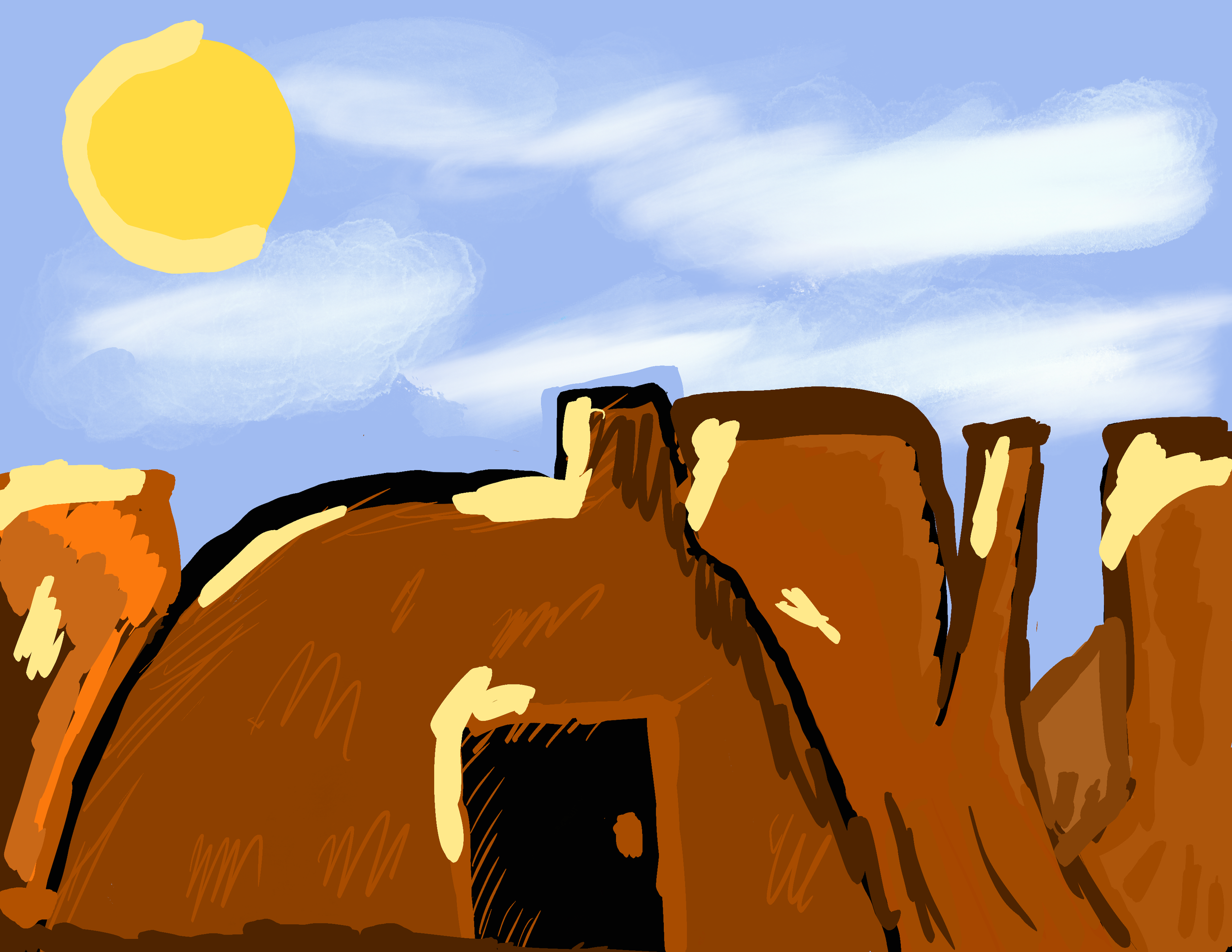
Figure 2
It is through Raya’s story and its lessons that we learn how youth can interweave Hózhǫ́ throughout their digital storytelling process by taking care of knowledge (story).
Findings
Carrying Stories
Raya, in the focus group interview shared where a lot of her inspirations came from in the creation of her digital story.
She described how she carried her story across time, space, and land.
Raya recalled being inspired to make a story about her hair, because it is something she carries with her not only as a story but also on her physical self.
She initially shared how she carries with her stories of the Navajo peoples’ Long Walk and a book about the Navajo Code Talkers she read in school. Specifically, she shared:
“...when I was reading a book Navajo Code Talkers, at my school and it was really interesting. And it was really fun to learn about … the Navajo people and different tribes having to like cut off all their hair and having to … go to boarding school. And actually hearing it from someone who went to boarding school, my family, was really interesting and it was really sad to hear. So I got that idea from learning about real experience and putting drawing and like and like technology into it. And it was really fun to do it and like have this experience to be in [the Native Education Program]. And to like do this.” (Focus Group, 06/2025).
Raya further described how she carries Diné cultural knowledge shared with her by her mother, which also shaped the digital story she presented. In particular, she reflected on the memory of why it is important to keep one’s hair long:
“And also it was my hair because I cut my hair off a bunch of times when I was little. And I was happy to cut off my hair, but my mom, she doesn’t want us to cut off our hair because she wants the memories. Because people say that hair is the most important memory to you because you grow with it and it stays with you” (Focus Group, 06/2025).
In carrying these stories, Raya not only names what inspired her ideas but also empathizes with her ancestors— those from her tribe and also from other tribes. As she learned about her ancestors' journeys and connected those stories with her mother’s desire for Raya to keep her hair long, Raya's storytelling process move in Hózhǫ́ and Ké by acknowledging everything profoundly and positively. This practice of carrying a story is also mirrored in how the program director (Author 3), as a Diné Knowledge Holder, shared with the youth stories she has carried. One of these stories connects with a memory Author 3 would often share with the youth:
“they put all of us in the same room…and there was about 30 other Navajo girls that were going through the same experience as I was… and you know what they did first off? They cut our hair. My long hair that was down past my knees got cut off. In fact it was cut off right below my ears” (Lesson from Author 3, 01/2025).
Through her digital storytelling process, Raya teaches us that when we share the stories we carry, we then carry them even further. For example, Raya explicitly acknowledged others’ stories of those who came before her, then took care of those stories by weaving all the stories she carries about her hair throughout her digital story. We share more about this process in the representing thread below. Taking care of her story then led her to care for the next set of listeners’ wellbeing by centering the emotion of hope in her story's design, flow, tone, and message. She explained this carrying of a story with a metaphor of dancing:
“And like dancing, like I wanted to show the emotion and what can come next if you just have hope. Like the Long Walk, when people had to like walk so long. Like they and then now, we live like peacefully with the Americans.” (Focus Group, 06/2025)
Here Raya reveals how she carries her stories as carrying both the topic or content of her story and how the story is told; she wants her story to flow like dancing. This flow metaphor shows how she describes the emotion of hope that she wants the audience to carry. Raya carries stories as her own, as demonstrated in her storytelling, by holistically capturing the complete set of stories that inspire and help define her upbringing and identity, and acknowledging them with care and reverence. In reflection, we see that Raya invites people into stories — good or tragic — and alchemizes them into hopeful messaging and design in her digital story. Interestingly, she reflects that her process was to put “technology into [her story]” (Focus Group, 06/2025) rather than put her story into the technology. Drawing on her metaphor of storytelling as flow, Raya demonstrates an underlying reverence for her stories throughout her process of digital storytelling, which extends from Hózhǫ́ and Indigenous ways of knowing, being, and doing, particularly in creating with or for openings in a design that let a spirit out and can never be contained (Isaacs, 2022).
Sharing Stories
In the second thread of Raya’s digital storytelling process, she chose to share a whole story through her digital storytelling process by acknowledging a more truthful version of already occurred events; her creation ‘materialized’ history and further shared what it’s like to be an Indigenous youth today, which was the theme the coordinators of the Native Education program invited youth to consider in their stories (Fieldnotes, 01/2025). Raya shared her story in a way that pays respect to herself and the wisdom she’s acquired. In sharing a story she carries, Raya describes a process of acknowledging the past and creating a bridge to the present by drawing on inspirations from stories that she carries with her, books she has read, the land she acknowledges as Mother Earth, and people/communities she has learned from. Raya’s creation and willingness to share the whole story bring about healing and represents the wholeness that is intertwined in the framework of Hózhǫ́. She explained:
“..I wanted to share this video with you because a long time ago Native Americans and any other tribe were not allowed to keep their hair long…I wanted to show that again. To show the world and appreciate Navajo Code Talkers and…all the women that went through this tragic time that you had to go through…this is important to all of us and important to my culture and my community, so thank you. Thank you so much.” ( Transcribed from Digital Story Audio, 02/2025)
The excerpt above is one example of Raya’s intention in her digital story was to acknowledge history and bring it to life. Representing Hózhǫ́ through reverence, Raya interwove both her digital story and sharing of her story with acknowledgments that highlight how history is alive and woven into her being, which demonstrates how she makes connections across time spaces (past and present) in how she shared her story. She further reflected:
Raya: “I wanted [the audience] to feel happy an like understand where we’re coming from [referring to Native Americans]. Like my culture story is coming from [Diné]. Like how my people(s) perspective and my own perspective of the world and how that your hair can be a part of your life and… as I learn that you don’t really need to cut your hair if you wanna be this cool. If you wanna do it, it’s fine but like, you should keep your hair long to live life with your hair. Have more memory.” (Focus Group, 06/2025)
Raya wants people to understand where Native Americans are coming from and understand a gratitude-acknowledging perspective (Hózhǫ́’s principle of reciprocity), which captures her own perspective that she shares. She provides a juxtaposition in her sharing between a more Western perspective of cutting hair to be “cool” and her own Indigenous perspective that long hair is “more memory.” By sharing the memories hair holds and its importance to Native Americans, Raya offers insight into the relationships of Hózhǫ́ she found in her hair. For Native Americans, Raya explains that hair represents a connection to lived experiences, including family, clan, community, environment, spirit, and universe. Even so, Raya opened a space of acceptance and choice in one’s own hair, and balancing that with honoring those who have come before, other Native Americans, and the tragic histories experienced, which further illustrates how her sharing enacts the wholeness and balance of Hózhǫ́. In sharing her story, Raya interwove her voice, perspective, lived experience, and story with inspirations, knowledge, and wisdom that she carried with her to share a whole story about the importance of hair in Native American culture.
Representing Stories
In the third thread of Raya’s digital storytelling process, Raya teaches us how she navigated representing the stories she carried in the ways she wanted to share. Specifically, Raya explored Hózhǫ́ throughout her digital artworks, which represented her storytelling, and these artworks conveyed emotional truth, wholeness, and sacred beauty. Through specific design choices, Raya balanced her emotions of both hope and grief. For example, she explains how the colors she used and in the visual depictions of herself, her culture, history, and the land come together to represent the wholeness in Hózhǫ́.
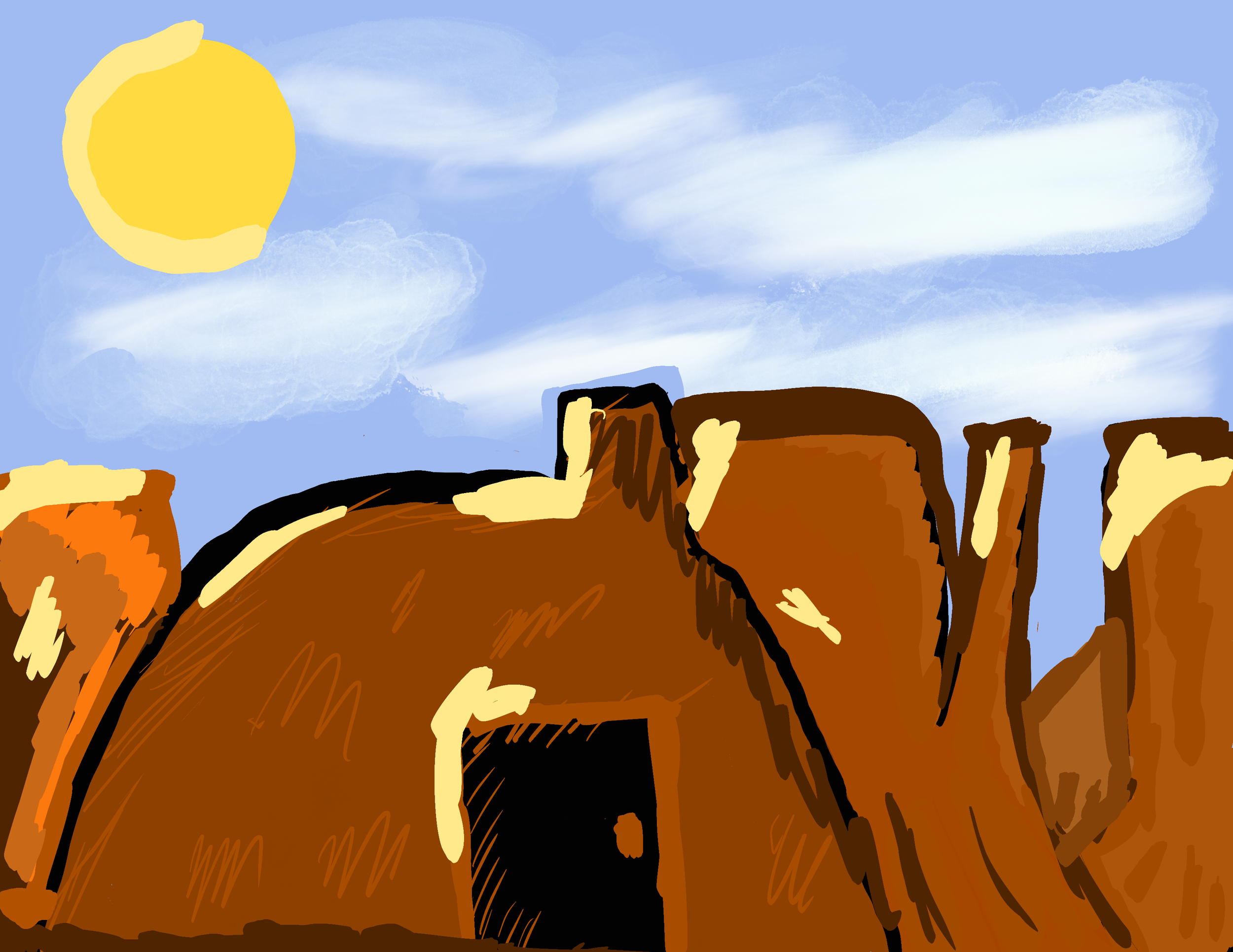
Raya’s digital story is a collection of digital artworks accompanied by her voice narration providing informational and personal context to the artwork. Raya describes her representation process as one of putting drawings and technology into her real life experiences (Focus Group, 06/2025). As an example, Raya described her thinking behind why she chose a Navajo hogan (see Figure 1) as the initial artwork displayed after her title screen:
“I really uh the hogan inspired me because when there’s [Tribal Educator] and [Author 3] talks about hogans and them living in it, I was inspired of that. And that’s my home to me. Cause my dad’s sister had a hogan and it and I went into it and it was just beautiful. So that’s like my that’s like I wanted to say this is my way of grow— like this is how I grew up in this world and how Mother Earth gave me.” (Focus Group, 06/2025).
Raya explains above how part of her choices around representation further her goal of sharing the whole story. Specifically she explained her purpose behind starting her story with a hogan drawing to help represent her personal story of where she grew up and how Mother Earth brought her to this place. By giving this recognition to nature and to self, Raya’s digital storytelling process exemplifies Hózhǫ́ ways of acknowledging and giving gratitude to the connection between self and Ké others and Ké land.
Figure 1
Raya’s digital art representing a Navajo hogan.
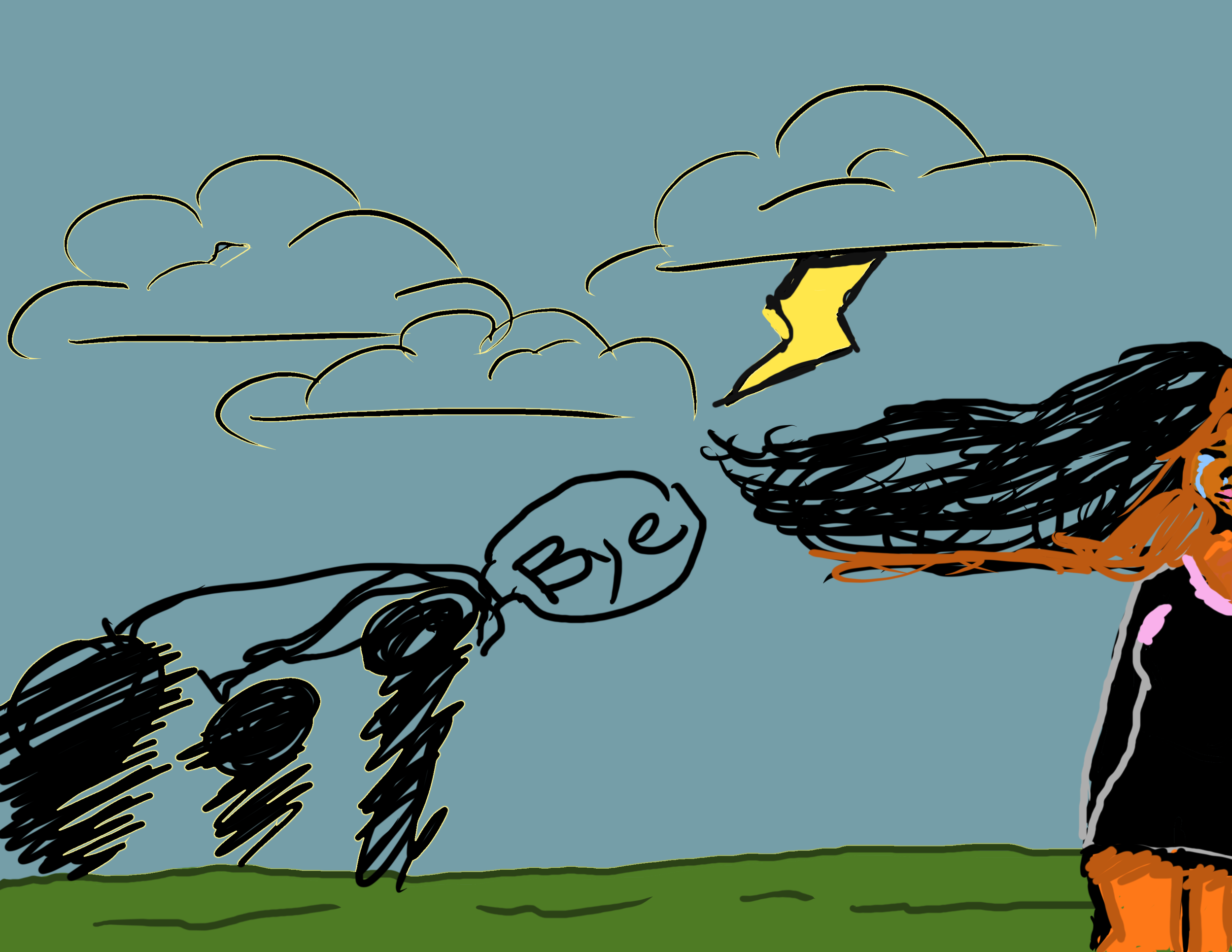
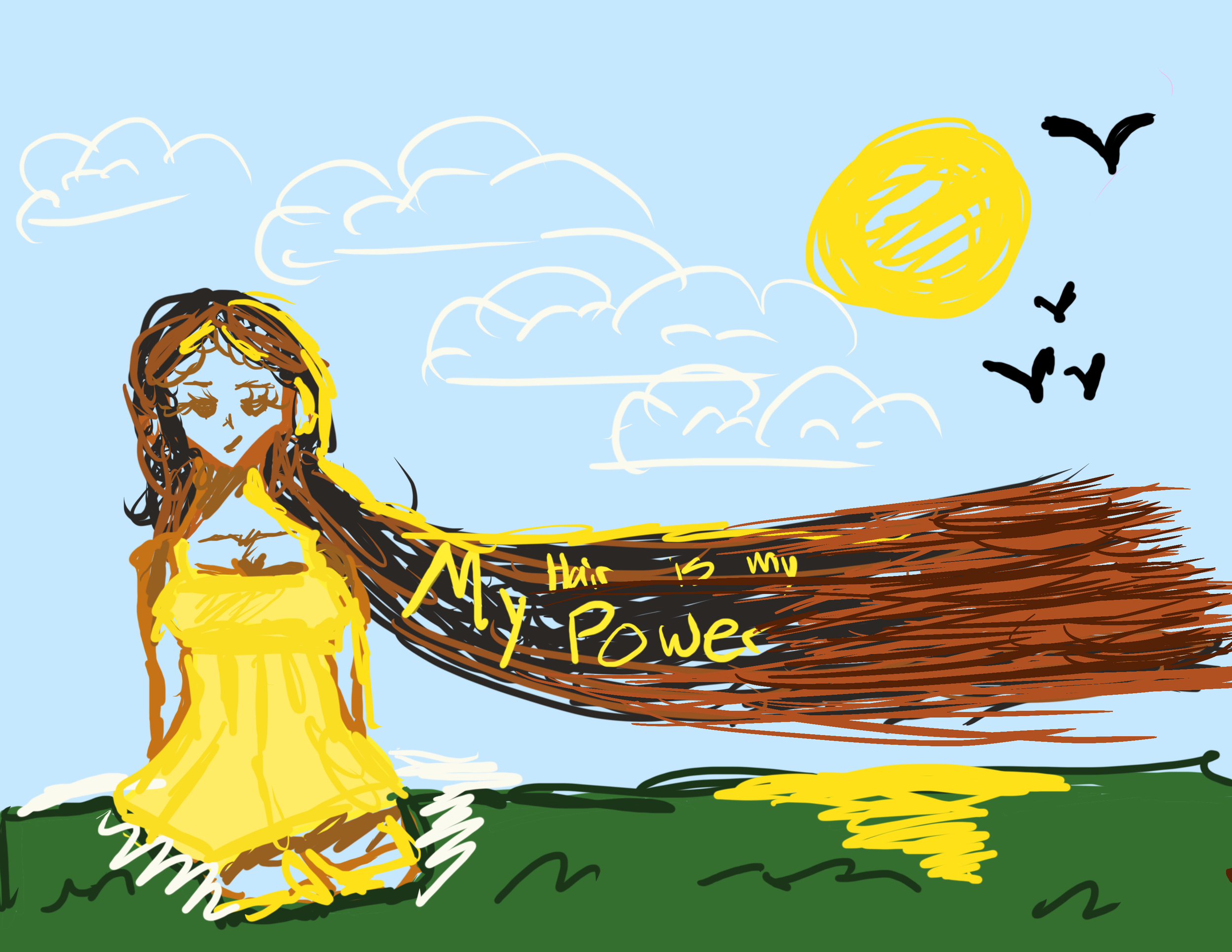
In following digital artwork, Raya explored representing her story through colors and self-depictions. For example, she reflected on moving away from the hogan to a new city and portrayed what it felt like to leave her friends behind (see Figure 2, right). In this digital artwork, the background colors are dark and the scene includes clouds and lightning to indicate a thunderstorm as well as her friends as scribbled figures, saying ‘bye.’ She also included a self portrait of her crying as she leaves. In the focus group interview, Raya explained that this artwork is “like me having to say goodbye later in my life” (Focus Group, 06/2025). This imagery is in contrast to the digital artwork that appears later (see Figure 2, left), which includes a bright blue background with the sun shining, birds flying, and white outlined clouds. In this digital artwork, Raya drew her self portrait with a yellow dress and a slight smile on her face. She also included the words ‘My Hair is my Power’ as a banner across her hair. In the focus group interview she reflected on how this digital artwork is “the next slide is… me...coping with after that and having just my strong sense and my bravery. And having to come over that fear and all my fears and…then like becoming more strong and less nervous, having less anxiety” (Focus Group, 06/2025).
Figure 2
Raya’s digital art representing her move away from her friends (left) and her Self portrait representing strength (right).
Raya’s approach to representing her story further enacts Hózhǫ́ by sharing a balanced and whole story across histories (Figure 1), time (Figure 2), and emotion (Figure 2). She demonstrated this through design choices of the order of the story, artistic expression choices of color, and throughout her audio narrative. Across Raya’s digital story, she tells a story of having to overcome the challenge of leaving her friends behind, and how she then developed a “strong sense and bravery.” Her art represents an overall feeling, energy, and recognition of Hózhǫ́ principles, especially of respect and spirituality. For example, she showed respect toward her surroundings and environment, as she shares her experience of leaving a place close to her, overcoming her struggle, and becoming stronger than she was before. There is also a sense of spirituality throughout her representation, particularly in how she acknowledged her past, the experiences that have shaped her, and keeping space for this to inspire her future.
The wholeness of her story is captured through representations through color, self-depictions, and lived experiences. Raya described “And then the last one is just like…growing what can come over you when you don’t have that fear and have that sadness. And like what could come over that and like what happens next.” There is a beauty, a wholeness in being, encompassed in this digital story and her representation of it. Through Raya’s process of putting “technology into [her story]” (Focus Group, 06/2025) she created and expressed feelings and experiences, self-determined who, what, and how her story was told, and enacted her sovereignty in a complete, wholistic, healing, harmonious, and beautiful way – Hózhǫ́. Raya brought her feelings to life through colors and self portraits, which enriched how she represented her story – the whole story.
Discussion
In this study, we sought to understand how a Native youth enacts Hózhǫ́ through digital storytelling. Through deeply engaging with one digital story and its creator, we learned several teachings from a Diné youth, Raya, who shared her process of storytelling as one that includes carrying, sharing, and representing. Her process enacts Hózhǫ́ by teaching us how to care for stories by acknowledging the past, present, future, ancestors, family, future generations, community (including the audience of her story), and more-than-human and nature elements. Thus, Raya teaches us to “love to hear stories about [the] pasts of people… [be] inspired to put their experience into my story” (Focus Group, 06/20205) which then results in a kind of whole story.
Hózhǫ́ as learning
In the space of the Native Education program that enacts Tribal sovereignty and supports Native youths’ self-determination, Raya’s story teaches us about Hózhǫ́ as a framework not only for storying but also for learning. Building from the frame of the Hózhǫ́ Reslience Model (Kahn-John et al., 2015), Raya teaches us how to weave spirituality, respect, reciprocity, discipline, thinking, and relationships throughout her digital storytelling learning process. Similar to the call to braid sovereignty (Morgan et al., 2025), each thread of carrying, sharing and representing serve as invitations for us to consider wholeness and balance across relationships, histories, and knowledges. Through centering cultural ways of knowing and being and honoring youth as story-holders and -tellers, these learning environments can be spaces of futuremaking opportunities: opportunities to carry, share, and represent stories through self-determination and sovereignty (Brayboy, 2005; Lees & Bang, 2022).
We share these teachings from Raya to guide the design of learning environments that center youths’ wellbeing and healing by allowing carrying, sharing, and representing stories as survivance (King et al., 2015). We learn from Raya about the significance of supporting youths’ self-determination and agency throughout the design process. She also teaches us how to recognize the nuance in youths’ storytelling process itself (e.g., carrying, sharing, and representing) through Hózhǫ́’s lifegiving framework. These lessons invite us to consider dignifying design principles in sociotechnical learning by drawing on culturally-situated frameworks that liberate youth to deeply examine themselves as stewards of their own culture. While our cultural context inherently supported youth to consider multiple dimensions of their story, such as history, time, and emotion, these elements, along with others, can be designed for and scaffolded. For example, simply offering youth a range of technologies and tools can invite them to explore multiple elements of their stories and lived experiences.
Furthermore, moves to disregard culture and diverse ways of knowing and being affects the ways in which youth can engage in their own learning (Bang et al., 2012; Brayboy, 2005; Castagno & Brayboy, 2008). Author 3, Diné Knowledge Holder, describes this doctrination of the American education systems as an act of silencing voices, especially the voices of Native youth. With Hózhǫ́ as a learning framework, the whole story surfaces and serves to heal what dominant knowledge seeks to silence: the celebration of Native youth relationship to themselves, to their culture, their stories, to their ancestors, and to their futures. In this way, designing for whole storytelling is an act of resistance. In our Native–predominately Diné–cultural context, Hózhǫ́ offered a cultural reference point from which youth envisioned thor stories as enactments of balance or wholeness. While we believe this translates to other cultural contexts, we also invite designers and researchers alike to consider culturally-specific references points with which youth can define their stories as whole.
Hózhǫ́ as whole storying
Inspired by related work around restorying (e.g., Shaw et al., 2023; Stornaiuolo & Thomas, 2018), we consider Raya’s enactment of Hózhǫ́ as a form of whole storying. From this stance, the goal is not only on restorying from a stance of resistance, but also on carrying, sharing, and representing the whole story with balance, completeness, or Hózhǫ́. Author 3, a Diné Knowledge Holder, offers further guidance that: healing comes from sharing the whole story. Taking this together, we suggest whole storying as a form of storytelling that Native youth and their families engage in their enactment of Hózhǫ́. Whole storying expands our understanding of how learning happens through digital storytelling to include more holistic and healing frames (e.g., Ellington et al., 2024; Jurow et al., 2025) of learning. It is in this reciprocity between sharing the whole and becoming whole where Raya’s journey inspires us as researchers to begin an infinite journey toward Hózhǫ́. Raya began her journey with us with short hair and now, years later at the time of writing, her hair continues to grow–this is Hózhǫ́.
References
Tachine, A., & Nicolazzo, Z. (Eds.). (2022). Weaving an otherwise: In-relations methodological practice. Taylor & Francis.
Archibald, J-A. (2008). Indigenous Storywork: Educating the Heart, Mind, Body, and Spirit. UBC Press.
Bang, M., Warren, B., Rosebery, A. S., & Medin, D. (2012). Desettling expectations in science education. Human Development, 55(5–6), 302–318. https://doi.org/10.1159/000345322
Bang, M., Faber, L., Gurneau, J., Marin, A., & Soto, C. (2016). Community-based design research: Learning across generations and strategic transformations of institutional relations toward axiological innovations. Mind, Culture, and Activity, 23(1), 28–41. https://doi.org/10.1080/10749039.2015.1087572.
Bang, M., Ovies-Bocanegra, M. A., Hoffman, C., Bruce, F., Barry, N., Sherry-Wagner, J., ... & Germinaro, K. (2025). Cultivating Wellbeing in Learning Environments: Storywork, Kinship and Affect With Lands and Waters. In Proceedings of the 19th International Conference of the Learning Sciences-ICLS 2025, pp. 2496-2504. International Society of the Learning Sciences.
Barak, A. (2022). Fusing horizons in qualitative research: Gadamer and cultural resonances. Qualitativel Research in Psychology, 19(3), 768-783.
Brayboy, B. M. J. (2005). Toward a tribal critical race theory in education. The urban review, 37, 425-446.
Castagno, A. E., & Brayboy, B. M. J. (2008). Culturally responsive schooling for Indigenous youth: A review of the literature. Review of educational research, 78(4), 941-993.
Coffey, W., & Tsosie, R. (2001). Rethinking the tribal sovereignty doctrine: Cultural sovereignty and the collective future of Indian nations. Stan. L. & Pol'y Rev., 12, 191.
Deloria Jr, V. & Wildcat, D. R. (2001). Power and place: Indian education in America. Golden, CO: Fulcrum Publishing.
Ellington, T., Tehee, M., Litts, B. K., & West, D. (2024). Konaway Nika Tillicum Native Youth Academy:
Enacting a medicine wheel educational framework. Cultural Diversity & Ethnic Minority Psychology.
French, B. H., Lewis, J. A., Mosley, D. V., Adames, H. Y., Chavez-Dueñas, N. Y., Chen, G. A., & Neville, H. A.
(2019). Toward a Psychological Framework of Radical Healing in Communities of Color. The
Counseling Psychologist, 48(1), 14-46. https://doi.org/10.1177/0011000019843506 (Original work
published 2020).
Isaacs, D. S. (2022). Together, Our Voices Will Strengthen the Weaving: Using Autoethnography and Narrative Inquiry to Indigenize Sense of Belonging in Higher Education (Doctoral dissertation, Utah State University).
Jurow, A. S., Mendoza, E., & Cortes, K. L. (2025). Can we design for healing in the learning sciences?. Journal of the Learning Sciences, 1-21.
Kahn-John, M., & Koithan, M. (2015). Living in health, harmony, and beauty: The Diné (Navajo) Hózhó wellness philosophy. Global advances in health and medicine, 4(3), 24-30.
King, L., Gubele, R., & Anderson, J. R. (2015). Survivance, Sovereignty, and Story: Teaching American Indian Rhetorics. University Press of Colorado.
Ko, D., Bal, A., Lim, S., & Orie, L. (2024). Fugitive future making: Empowering voices, amplifying sociopolitical imaginations, and designing transformative futures. Review of Education, Pedagogy, and Cultural Studies, 46(4), 672-699.
Lees, A., & Bang, M. (2022). We’re not migrating yet: Engaging children’s geographies and learning with lands and waters. Occasional Paper Series, (48), 33-47. DOI: https://doi.org/10.58295/2375-3668.145.
Litts, B., Haws, D., Morgan, C., Quintana, E., Allison, A., & Mills, T. (2025a). Self-Determined Storytelling: Native Youths’ Digital Restorying Practices in an American Indian Education Summer Camp. In Rajala, A., Cortez, A., Hofmann, R., Jornet, A., Lotz-Sisitka, H., & Markauskaite, L. (Eds.), Proceedings of the 19th International Conference of the Learning Sciences - ICLS 2025 (pp. 1734-1738). International Society of the Learning Sciences.
Litts, B. K., Morgan, C., Haws, D., Quintana, E., Allison, A., Pete, C., Pete, C., Jenkins, J., Baggaley, S., & Cawley, J. (2025b). A Healing Research Interface: Coming Together to Create Indigenous Learning Experiences Through Community-Driven Design Research. In Rajala, A., Cortez, A., Hofmann, R., Jornet, A., Lotz-Sisitka, H., & Markauskaite, L. (Eds.), Proceedings of the 19th International Conference of the Learning Sciences - ICLS 2025 (pp. 1933-1937). International Society of the Learning Sciences.
Lyons, S. R. (2000). Rhetorical Sovereignty: What Do American Indians Want from Writing? College Composition and Communication, 51(3), 447–468. https://doi.org/10.2307/358744.
McCarty, T., & Lee, T. (2014). Critical culturally sustaining/revitalizing pedagogy and Indigenous education sovereignty. Harvard educational review, 84(1), 101-124.
Medico, D., & Santiago-Delefosse, M. (2014). From reflexivity to resonances: Accounting for interpretation phenomena in qualitative research. Qualitative Research in Psychology, 11(4), 350-364.
Mendoza, E., Padilla-Chavez, A., Salazar, B., & Jurow, A. S. (2024). Integrating learning and hummingbird medicine to heal academic harm. Journal of Ethnic and Cultural Studies, 11(5), 211-229.
Moodley R., West W. (Eds.). (2005). Integrating traditional healing practices into counseling and
psychotherapy. Thousand Oaks, CA: Sage.
Morgan, C., Litts, B., Tehee, M. et al. (2025). Honoring sovereignties through technology within indigenous community research partnerships. J Comput High Educ 37, 695–711 (2025). https://doi.org/10.1007/s12528-025-09451-7.
Nasir, N. I. S., Rosebery, A. S., Warren, B., & Lee, C. D. (2006). Learning as a cultural process: Achieving equity through diversity. In R. K. Sawyer (Ed.), The Cambridge handbook of: The learning sciences (pp. 489–504). Cambridge University Press.
Quayle, K., Morgan, C., Litts, B. K., Yan, L., & Haws, D. (2023). Community-Driven Design: A Reorientation to Designing Tools for Learning With Communities. Proceedings of the 17th International Conference of the Learning Sciences-ICLS 2023, 1322–1325.
Shaw, M. S., Coleman, J. J., Thomas, E. E., & Kafai, Y. B. (2023). Restorying a Black girl’s future: Using womanist storytelling methodologies to reimagine dominant narratives in computing education. Journal of the Learning Sciences, 32(1), 52-75.
Stake, R. E. (2008). Qualitative case studies. In N. K. Denzin, & Lincoln, Y. S. (Eds.), Strategies of qualitative inquiry (pp. 119-149). Los Angeles: Sage.
Stornaiuolo, A., & Thomas, E. E. (2018). Restorying as political action: Authoring resistance through youth media arts. Learning, Media and Technology, 43(4), 345-358.
Vossoughi, S., Marin, A., & Bang, M. (2023). Toward just and sustainable futures: Human learning and relationality within socio-ecological systems. Review of Research in Education, 47(1), 218-273.
Wexler, L. (2009). The importance of identity, culture and history for indigenous youth wellness. The Journal of
the History of Childhood and Youth, 2(2), 267-276.
Winter, J., & Boudreau, J. (2018). Supporting Self-Determined Indigenous Innovations: Rethinking the Digital Divide in Canada. Technology Innovation Management Review, 8(2), 38–48. https://doi.org/10.22215/timreview/1138.
Yan, L., (2023) "Reimagining Culture With Youth: Relationship and Representation in Culturally Centered Learning Environments.”. All Graduate Theses and Dissertations, Spring 1920 to Summer 2023. 8797. DOI: https://doi.org/10.26076/0b12-44e4.